BEAUTIFUL MINDS
Dr Juan Botto
Postdoctoral Research Fellow
Faulkner lab
Queensland Brain Institute
"My research aims to unravel how certain genetic elements are regulated in the brain to provide solutions to predict neurodegenerative diseases and develop novel therapeutics."
"Science is often viewed as purely rigid and methodical, but every major discovery we make relies on an initial leap of creativity. Creativity drives every single experimental design and allows us to come up with novel ways to test complex unknown biological questions. Without a creative mind, data remains just information."
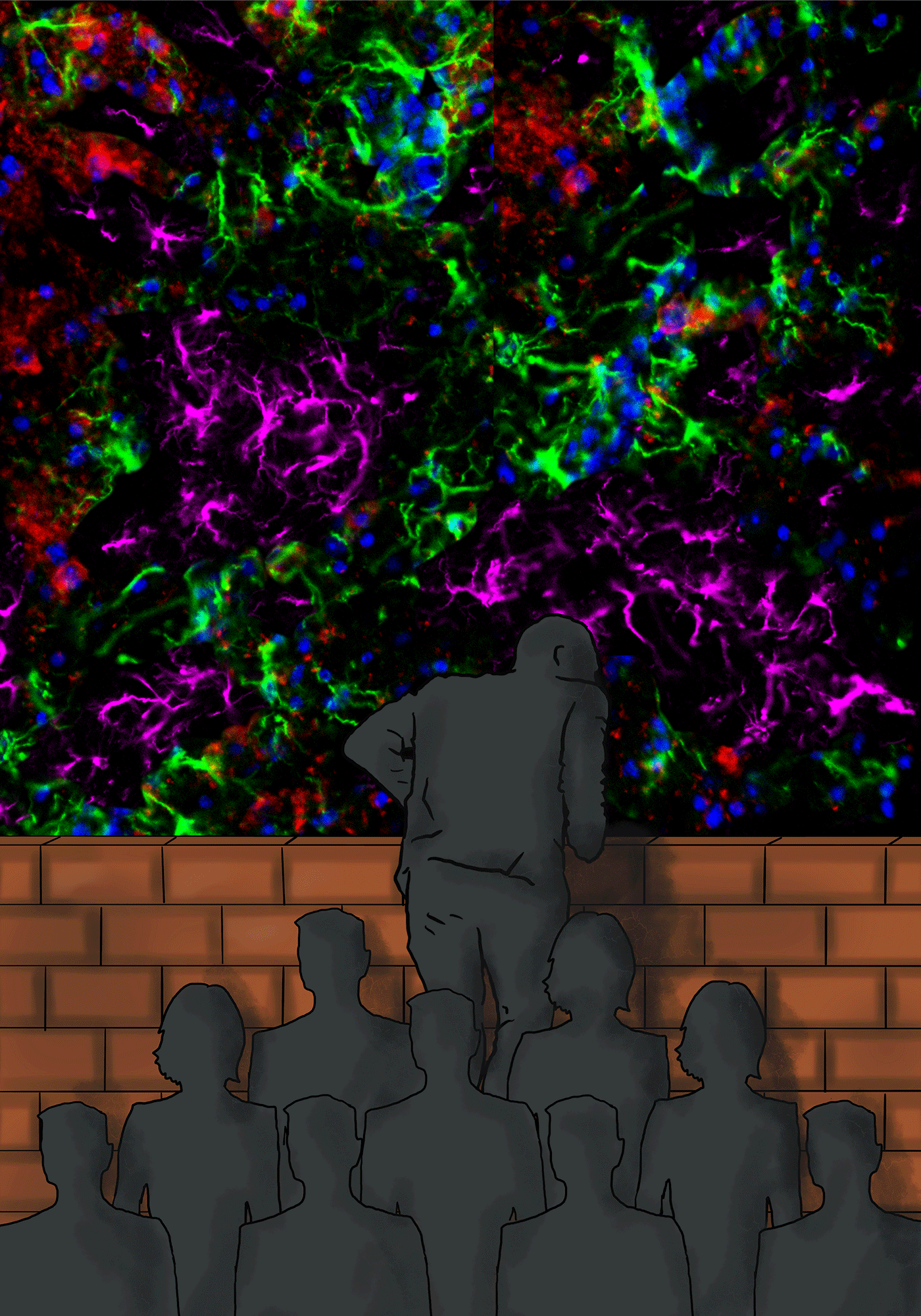
On the shoulders of giants
This is a mixed artwork that combines the drawing of a group of people standing on each other’s shoulders, so that the last one can observe an immunostaining of an adult mouse brain region located on the other side of a wall. The people here resemble us, the scientists, who dedicate our lives to building knowledge that passes to the next generations, so that, at some point in time, someone can generate a breakthrough, observe what has never been observed before and enlighten the world with knowledge that has been “hidden behind” this ignorance wall.
"The message behind this piece is that science and humanity only progress because of the constant synergies that we as individuals generate when we collaborate with each other. The take home message is that we need to work as a community and towards a better understanding of this world and its nature."
Juan's research
I am a postdoctoral researcher who works in the genetics field at the Queensland Brain Institute and at the Translational Research Institute. My work focuses on the study of certain “jumping genes”, named LINEs. Almost half of the human genome doesn't code for our body's building blocks, but rather comprises genomic parasites that can jump around our DNA. While these elements have driven human evolution over millions of years, their jumping can trigger genomic instability and disrupt vital genes, which have been implicated in neurodegenerative processes.
By uncovering the molecular mechanisms that control these “jumping genes”, we can both advance our understanding of how our brains work and evolve, and discover new therapeutical targets to fight complex genetic diseases, improving the quality of life of affected people.
"For me, creativity is the capacity to intertwine previously acquired knowledge with emerging ideas to solve problems or questions. Scientists are constantly making creative decisions in the lab: to solve problems that present daily in the lab, to invent new protocols to test a hypothesis, or to find ways of interpreting the raw and boring data we obtain and translate that into something impactful for science."




.png)