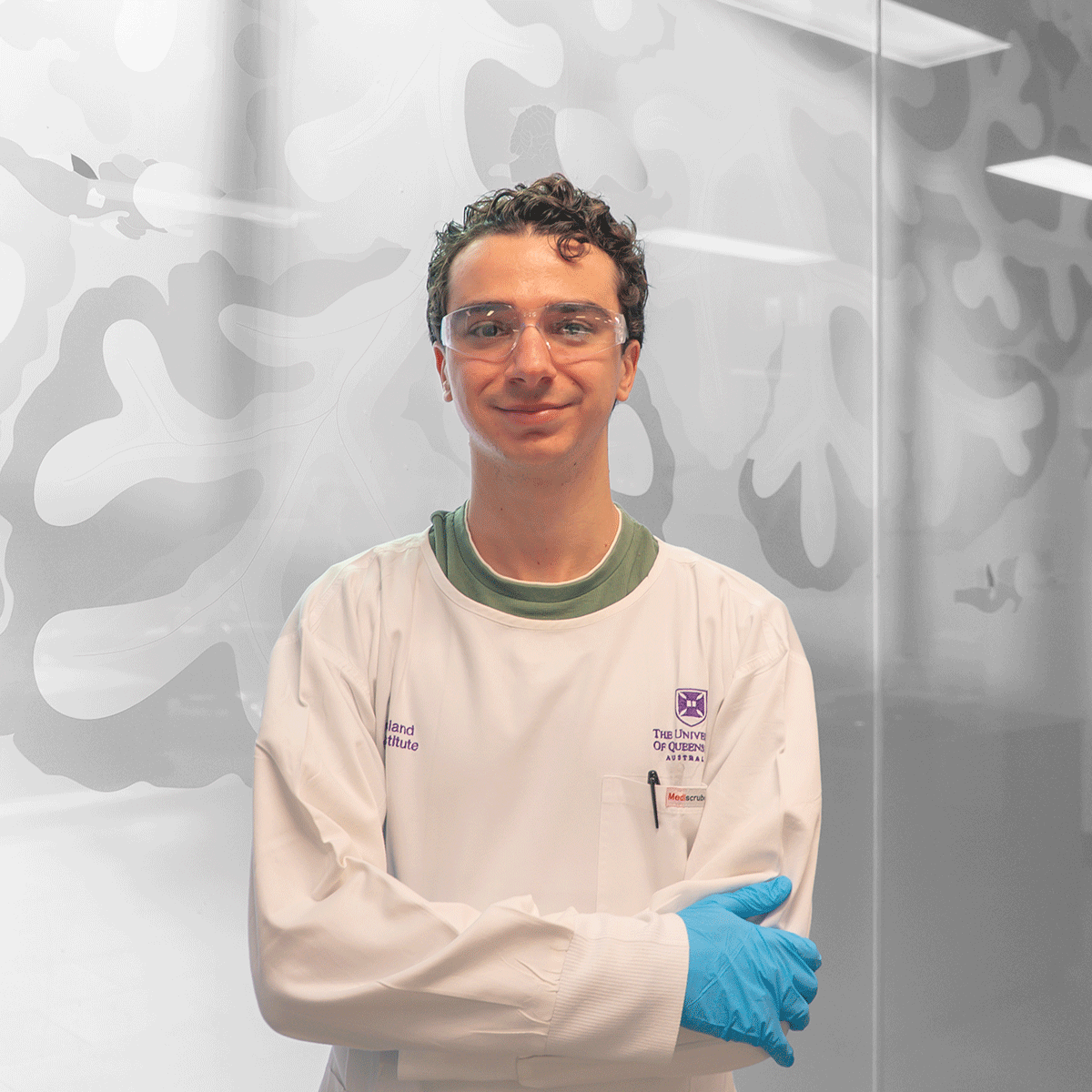
Dr Jonathan Chejfec-Ciociano
Senior Research Assistant
Meunier lab
Queensland Brain Institute
"I am a physician and postdoctoral research fellow inthe van Swinderen Lab at the Queensland Brain Institute.
Senior Research Assistant
Meunier lab
Queensland Brain Institute
"I am a physician and postdoctoral research fellow inthe van Swinderen Lab at the Queensland Brain Institute.
"We usually experience movement at the human scale as smooth, visible and often directional. At the molecular scale, movement is very different: irregular, constantly changing and shaped by interactions within the crowded environment of the cell."
Munc18 trajectories move simultaneously across the field, revealing the collective rhythm, density, and spatial diversity of single-molecule motion.
Molecular Disco shows the movement of individual Munc18 molecules in a PC12 cell. Each colored line represents the path followed by one molecule during the recording. The tracks are displayed together, creating a dense and dynamic view of molecular activity inside the cell. Some molecules move over longer distances, while others remain within smaller areas or frequently change direction. The colours help separate the individual trajectories and make the overall movement easier to observe. What may first appear to be an abstract digital animation is actually a visual representation of real experimental data collected using single-particle tracking.

Each Munc18 track emerges individually, highlighting the shape, direction, and variability of molecular movement through sequential animated strokes.
Molecular Calligraphy shows individual Munc18 molecules moving within a PC12 cell. Rather than displaying all trajectories at once, each track is drawn separately, allowing the viewer to follow one molecular path at a time. The lines vary in length, direction and shape, reflecting differences in how each molecule moves during the recording. Some tracks are short and confined, while others extend across a wider area. Presenting the trajectories sequentially makes the individual behaviour of each molecule easier to observe. Although the lines may resemble handwriting or abstract marks, they are based entirely on real experimental data collected through single-particle tracking.
My research examines how proteins involved in cellular communication move and interact, and how anesthetic drugs may alter these processes. I have a particular interest in th evisual analysis of data, using images and animations to identify patterns andcommunicate complex experimental results more clearly.




.png)