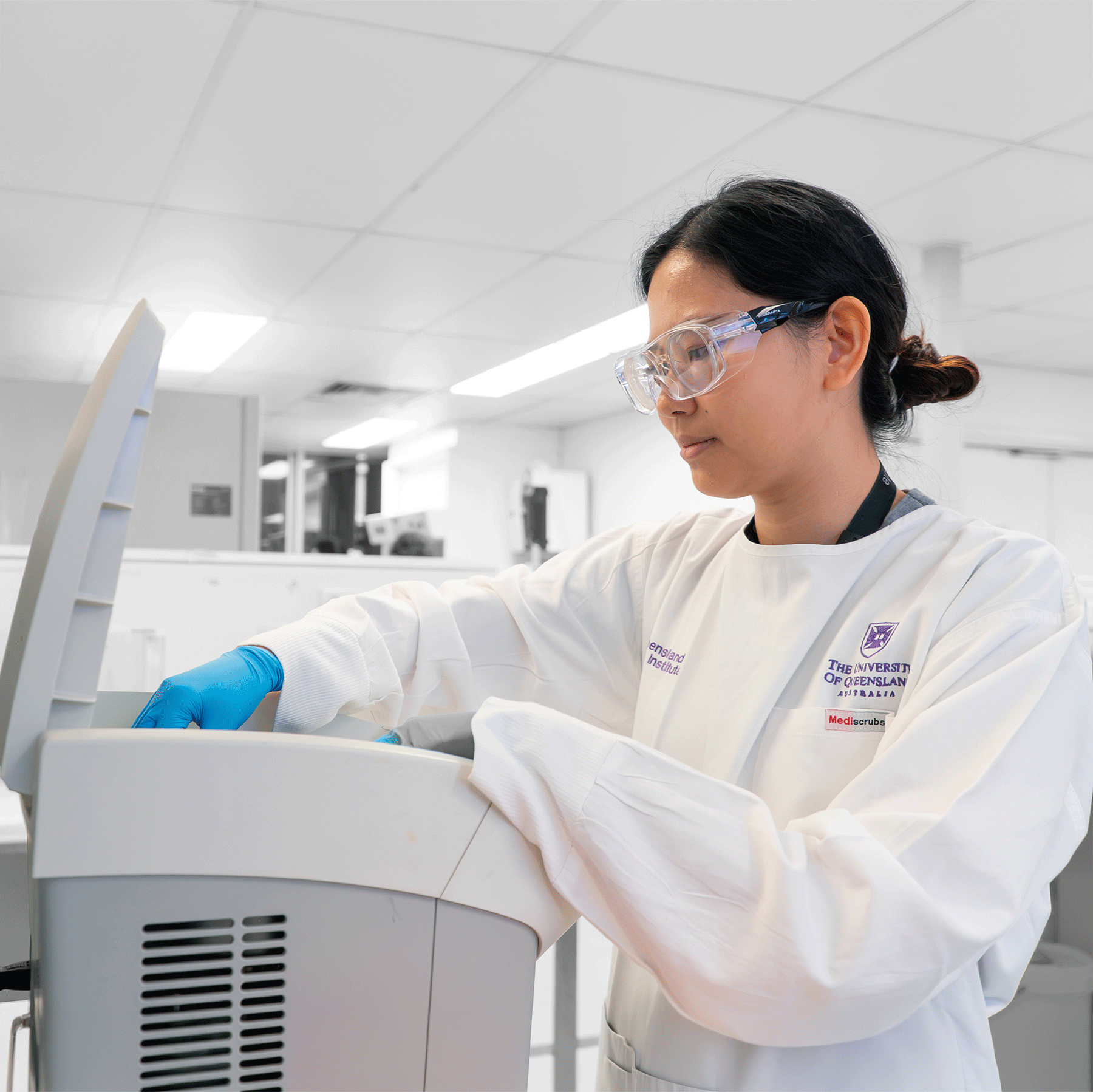
Christiana Lowis
PhD student
Anggono lab
Queensland Brain Institute
"Creativity means finding new ways to connect ideas, ask questions and communicate something that may not be immediately visible."
PhD student
Anggono lab
Queensland Brain Institute
"Creativity means finding new ways to connect ideas, ask questions and communicate something that may not be immediately visible."
"Creativity enters my research whenever I turn complex biological structures into images that can be understood visually. There is a sense of discovery in seeing structures that are normally invisible to the naked eye emerging as a coherent landscape. For me, microscopy is both a measurement tool and a way of seeing biology from a new perspective."
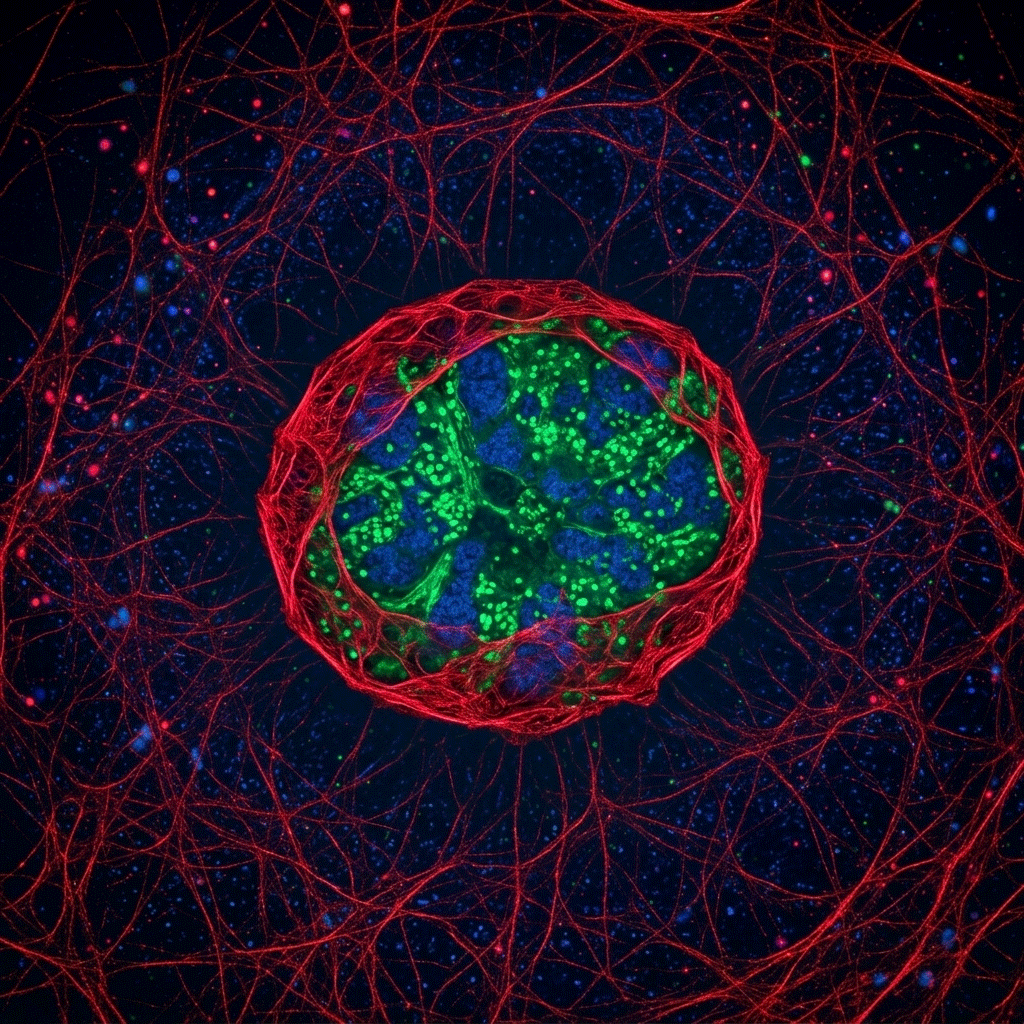
Histones shine like constellations within the nucleus, revealing the hidden architecture of life.
At first glance, this image resembles a glowing planet. A spherical structure emerges from the darkness, surrounded by a delicate red network, while vivid green signals fill the interior and blue structures mark the nuclei. The contrast between the bright fluorescent colours and the black background draws the eye toward the centre, inviting closer inspection. Fine threads weave around the outer boundary like a protective shell, while the dense green patterns create a sense of movement and complexity within. What appears abstract at first becomes a visual glimpse into the organisation of a living cell and the hidden architecture that supports its function.
.png)
The quiet rebuilt - slowly stitching itself back into radiance.
This image presents the anatomy of a mouse brain, carefully pieced together from broken fragments. Against the dark background, deep blue, teal and warm orange regions illuminate the separate pieces, revealing both their individuality and their connection to the larger whole. The image suggests that even small, imperfect fragments can come together to create something beautiful. What may first appear broken is not necessarily lost; it can be part of a journey toward becoming whole. Through its colours and composition, this brain anatomy becomes a reminder to have faith in the process of healing, reconstruction and transformation.
Christiana Lowis is a second-year PhD student in the Anggono Lab at the Queensland Brain Institute. Her research focuses on the role of Copine-6 in the epigenetic regulation of learning and memory, with particular interest in nuclear organisation, chromatin architecture and activity-dependent gene regulation in neurons. She is fascinated by the hidden structures within cells and enjoys using microscopy to make these microscopic processes visible. Her perspective combines molecular neuroscience with a strong appreciation for the visual and creative side of scientific discovery.




.png)